Revisiting the Unthinkable: Emergency Water
When the Soviets reached hydrogen bomb capabilities in 1955 followed by reliable ballistic missile delivery systems in 1960 Britain was quickly pressed into rethinking its entire nuclear defence strategies. No longer able to spot, plot, and intercept Soviet bombers within realistic timeframes or assure pragmatic rescue in the event of a nuclear strike the government transitioned to focus instead on the country’s longterm recovery and rebuilding in the aftermath of the unthinkable. This revised strategy centred around the scenario whereby a specially chosen cohort of representatives were safely dispersed from London and Edinburgh to maintain political machinery and orchestrate post-attack administration from a decentralised nationwide network of protected bunkers.
In England and Wales these protected bunkers became known as Regional Seats of Government (RSG) whereas Scotland installed a unique Scottish Central Control (SCC) system supported by three additional “Zones”. From here, civil servants and military personnel were instructed to carry out key duties in autonomously sealed conditions until informed otherwise. It was conceived that staff could either emerge from the bunker, subject to when radiation levels had sufficiently reduced, or (indefinitely) await relief from a backup crew stationed nearby.
After the Scottish Office took control of the bunker in 1961 with a combined staff of 200, RAF Troywood subsequently transitioned from a radar station to the Northern Zone Control and in doing so its architectural program underwent a significant reconfiguration. The Northern Zone covered Scotland’s largest designated region from Fife all the up to the Shetland Islands and was eventually afforded Raigmore (a WW2-era Raigmore bunker in Inverness) as the Deputy Zone Control to assist the mammoth task.
“The requirement here is to have a reserve of water of at least two gallons a head for twenty one days”
<Scottish Office memo to the Ministry of Works 19 October 1961>
Water Supply
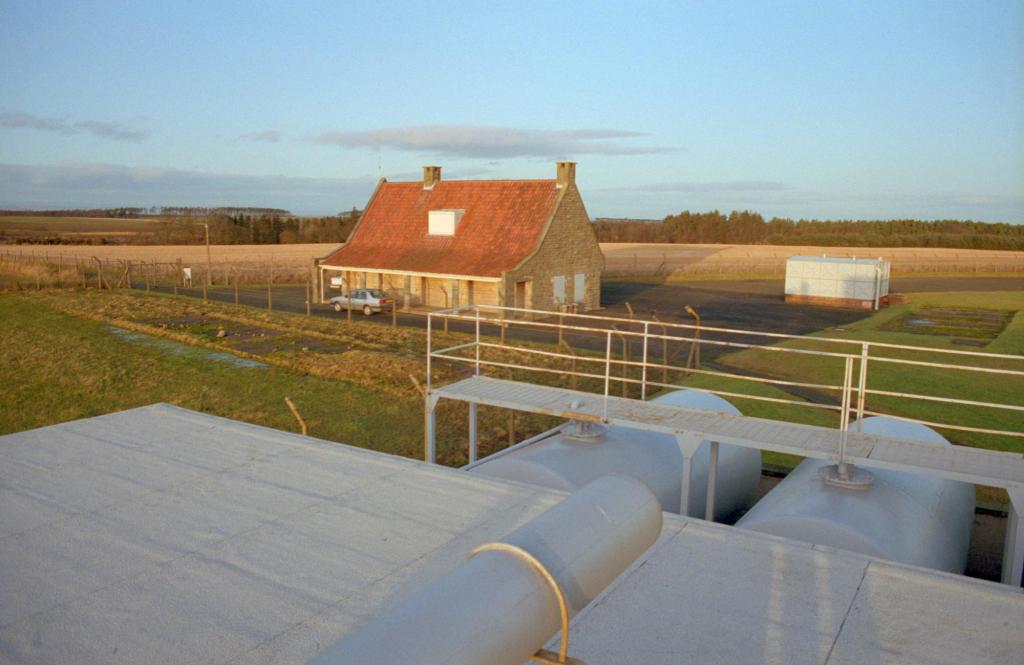
In peacetime, as with other building services within the bunker, water came direct from the national grid and was routed up to the site from a nearby pumphouse, which was itself disguised as an agricultural outbuilding to assist the bunker’s overall concealment. The schematics even fed some nearby cottages and cattle troughs! However, in the event a nuclear strike ruptured the mains an emergency water supply was stored as a backup measure. The bulk of this emergency water supply principally came from 14,000 gallons held in a sectional steel Braithwaite tank installed above ground by the Ministry of Works in the 1960s. When this had depleted a float switch triggered an alarm in the guardhouse to start the flow of a further 2,000 gallons that lay within 4 smaller attic tanks left by the RAF. During a post-attack period of lockdown, the government calculated that the 200 personnel (within the secured bunker) were to each have at least 2 gallons per day which, for a staff of 200, should have comfortably lasted them 40 days. It was assumed that the mains supply would have been repaired by this point or a relief force (stationed nearby in Anstruther) would have delivered additional tanks. The water would have undoubtedly been prioritised for drinking, and perhaps cooking. But there would be difficult decisions made on basic provisions for washing, shaving, sanitation (flushing the toilets) and the air conditioning system would have been an unlikely commodity during the uncertain period of underground living.

Braithwaite & Co. Engineers
Established as Braithwaite & Co. Engineers in 1921 the firm were initially known for their efforts in steel bridge building (actively contributing to the building of WW2 Bailey Bridges) but later expanded to a wide variety of heavy structural steelwork, operating extensively in India and Pakistan throughout the 20th century. Aside of the firm’s global operations they emerged as specialists in pressed steel sectional water tanks since 1901 and continue as industry leaders in water storage tanks today under the name Braithwaite Engineers Ltd.

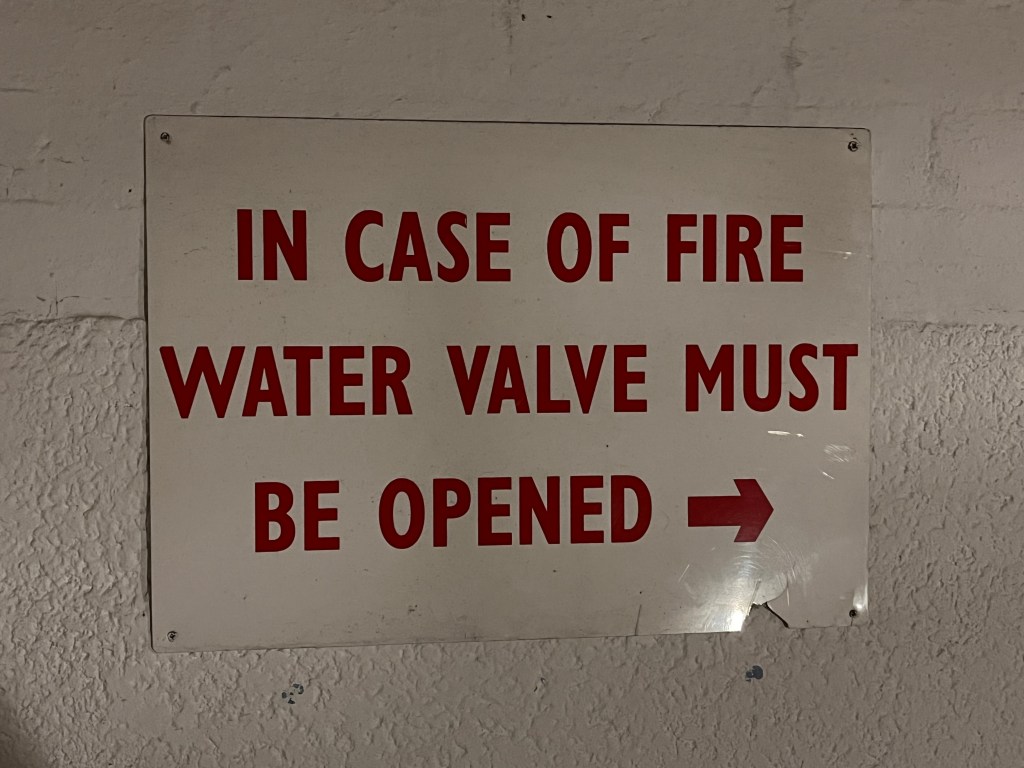
Even after 60 years of being exposed to the harsh elements the Braithwaite water tank still remains in place to this day. Although the 1200mm by 1200mm steel panels have mostly been recoloured in a DPM camouflage pattern to match the museum’s military scheme signs of its original white paintwork are still evident. The structure, mounted on ‘Weymes’ brick foundations, has been reconfigured as EV charge points to allow visitors free charging as they explore the bunker’s museum. Lastly, the pipework has been rerouted for fire fighting as the water supply now feeds the distinct red wall-mounted Pyrene fire hoses.
 Bunkerbuff
This is really unique, interesting stuff!
LikeLiked by 1 person